
The video call that cost $25 million
The email felt wrong, and the finance worker knew it. It came from the company's UK office, asked for a "secret" transaction, and carried the faint smell of a phishing scam. He hesitated.
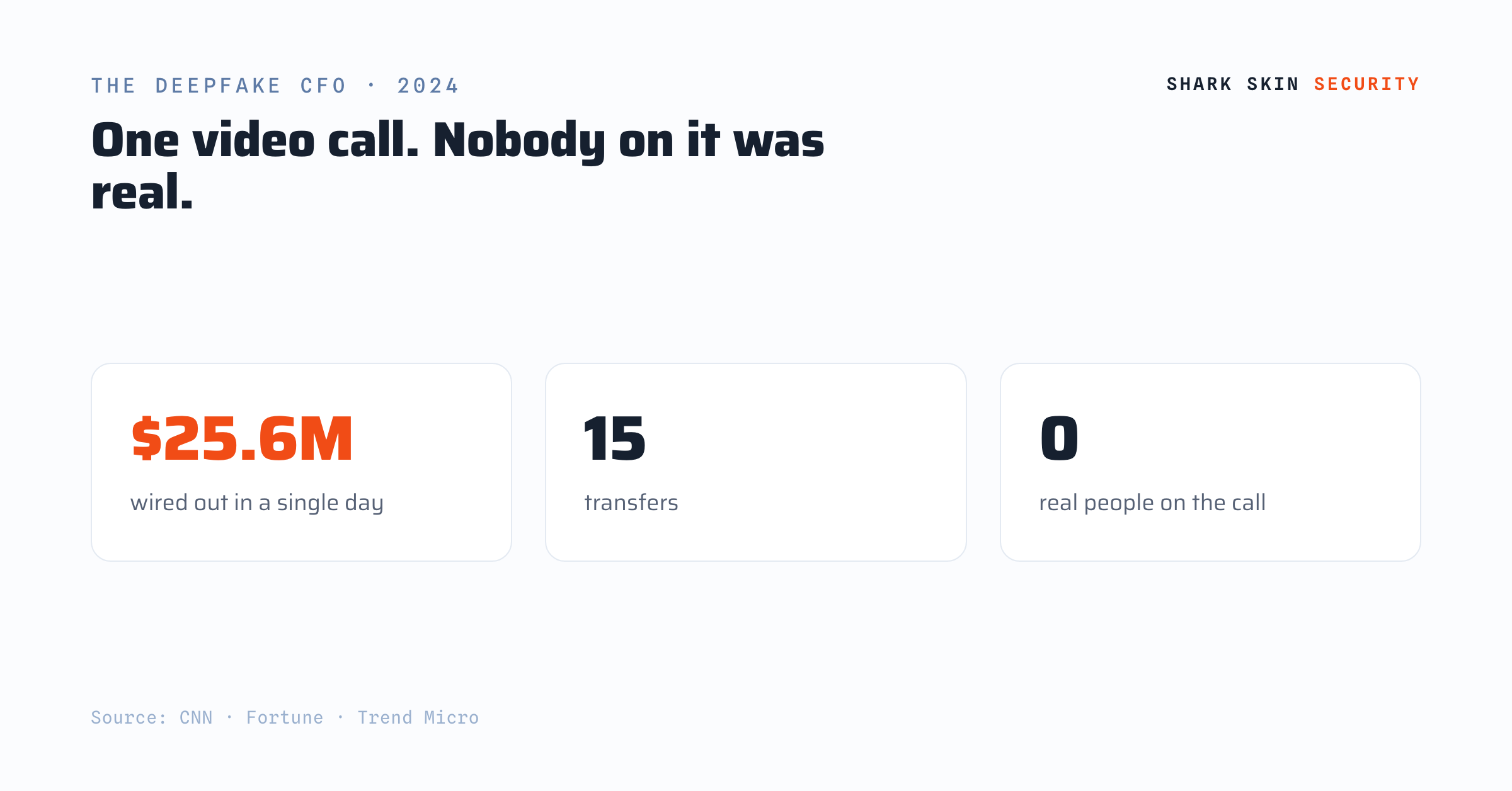
Then the video call began, and his doubts dissolved. There was the chief financial officer, and around him several colleagues the worker recognized — their faces, their voices, the small mannerisms you can't fake. Or so he thought. If the CFO and half the leadership team were on the call telling him this was real, who was he to argue? Over a single day, he made fifteen transfers totaling about $25.6 million.
Not one person on that call was real. Every face, every voice, was an AI deepfake — assembled from video and audio of the executives that anyone could pull off the internet. The company was Arup, the respected British engineering firm that once helped raise the Sydney Opera House. Hong Kong police disclosed the theft in early 2024. The money was never recovered, and no one has been arrested.
For years the advice about scams like this was simple: if a request feels off, pick up the phone and confirm with a real person. Hear their voice. Better yet, get them on video and see their face. The Arup attack detonated that advice. The entire point of a deepfake is that the voice and the face — the very reassurance you were taught to look for — can now be manufactured to order.
And the tools are no longer exotic. Researchers have shown a convincing clone of someone's voice can be built from as little as a few seconds of audio: a snippet of a podcast, an earnings call, a birthday video posted to Instagram. Deloitte's financial-services analysts project that AI-enabled fraud in the United States could climb from roughly $12 billion in 2023 to $40 billion by 2027.
So what actually holds up when your own eyes and ears can be forged? A rule that doesn't depend on recognizing anyone. One agreed, out-of-band way to authorize money — a callback to a number you already had, a second approver, a code word set in advance — used every single time, no matter who appears to be asking. The worker at Arup did the human thing: he trusted the room. The defense is to trust the process instead.
The uncomfortable part of the Arup case isn't that the man was foolish. It's that he did almost everything right. He was suspicious. He waited. He sought confirmation. The confirmation lied to him.
For a very long time, "seeing is believing" was sound security advice. It just quietly stopped being true.