You're not anonymous. You're for sale.
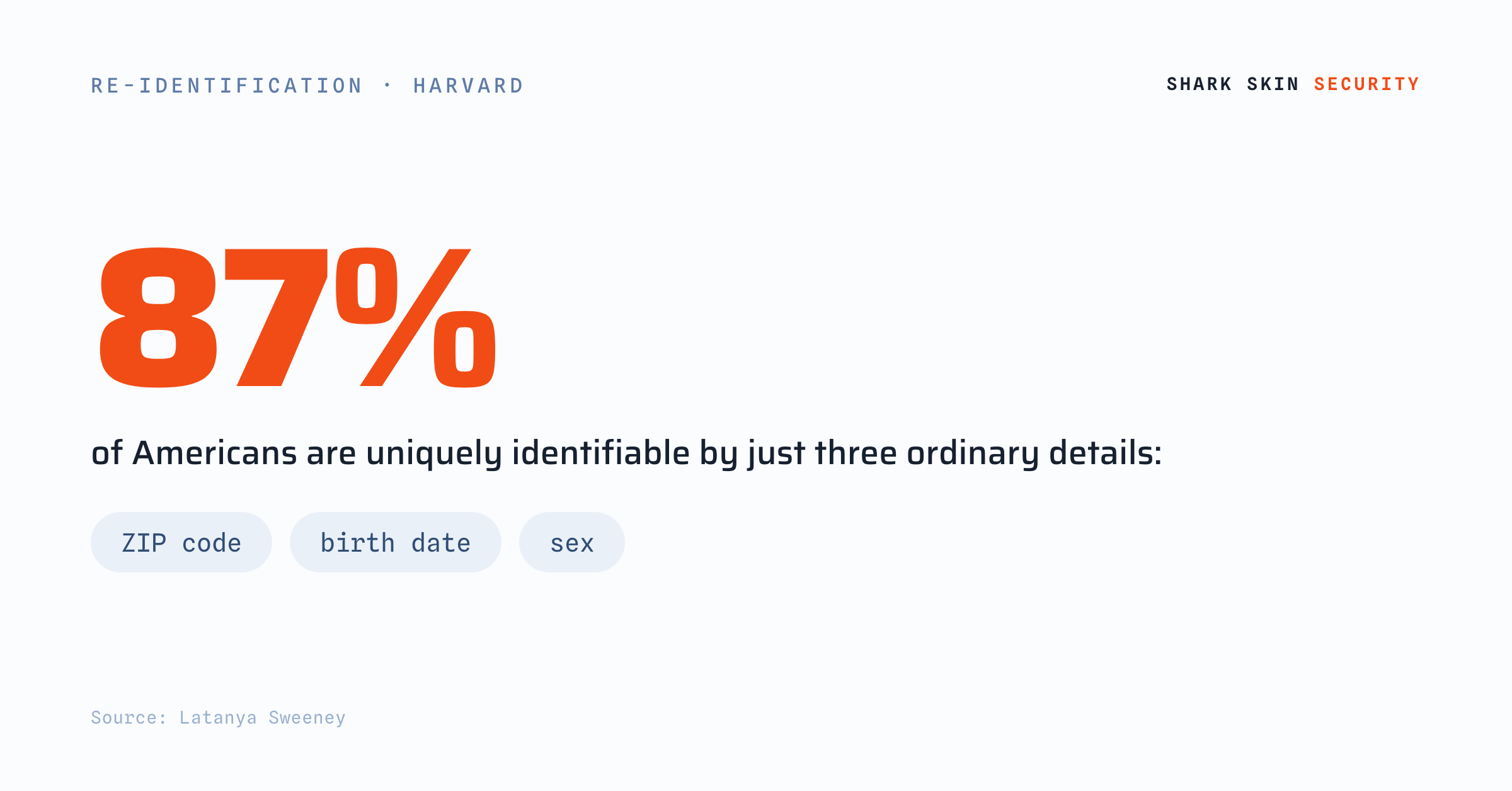
Here's a number that should be impossible. A Harvard researcher named Latanya Sweeney showed that roughly 87% of Americans can be uniquely identified by just three ordinary details: their ZIP code, their birth date, and their sex. Not their name. Not their photo. Three facts you've handed to a hundred forms without thinking — enough to pick you, specifically, out of a crowd of hundreds of millions.
That's the raw material of an industry most people have never knowingly touched: data brokers. Companies you've never heard of quietly buy, merge, and sell dossiers on nearly every adult in the country — home addresses, family members, estimated net worth, the car you drive, the hours you're usually home. When the U.S. Federal Trade Commission investigated the business, it found a single broker holding data on more than 700 million people, with thousands of attributes each. You never signed up. You can't easily see it. And almost anyone — a marketer, a stalker, a scammer building a convincing story — can buy it.
For most people this is an abstract nuisance. For someone with real assets, it's a starting map: the address for a burglary, the family names for a scam, the routine for knowing when the house is empty. Every "urgent" fraud you've ever read about got more convincing because the caller already knew things about you they shouldn't have.
The footprint can be shrunk. Your details can be pulled from the major broker sites, your public records tightened, your exposure monitored so it doesn't quietly creep back. It's tedious, repetitive work — which is exactly why it's worth having someone do it for you, once and then continuously, so you stop being the easiest profile to buy.
You can post nothing, lock every account, and still be the most thoroughly documented person at your own dinner table. The question was never whether there's a file on you. It's who's allowed to open it.